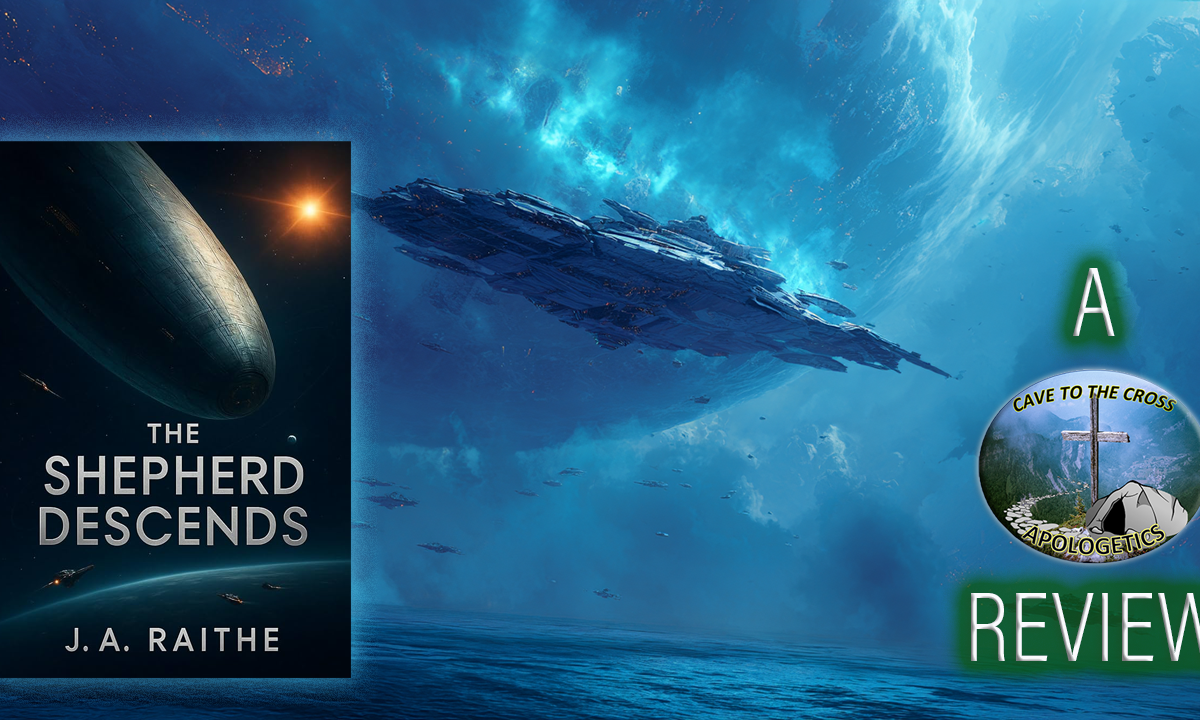
The Shepherd Descends
The Shepherd Descends by J.A. Raithe
Synopsis:
When a colossal alien ship decelerates and halts at the edge of the solar system after centuries of silent observation, three rival human factions—Earth’s political elite, Mars’ hardened colonists, and outer system outlaws—scramble to make first contact. Seventeen representatives board their respective vessels, discovering not advanced gifts but a crucible of trials crafted to assess humanity’s character and worthiness for survival. As the tests strip away pride, ambition, and illusions, tensions escalate amid profound revelations about what it means to be human.
Video
Review
I was interested in this first contact book from an indie author’s point of view as it involved different human factions attempting to make contact with alien visitors who were testing humanity. Sounded promising. I was overjoyed in reading this book. The format that Raithe has structured the novel is each chapter has an A and B side where humanity’s point of view is represented with the A section and the B side is the Shepherd alien point of view. It’s clear from the start that the alien contact is superior from every species it has encountered and very much so with respect to humanity. Humanity has broken free of being Earth only with the usual colonies on the asteroid belt and Mars, so a future humanity but not one long removed from the present reality.
The three aspects of humanity start as representing a very capitalistic system (Earth/Moon), military (Mars), and anarchy/open information society (Belt). The leaders tend to be the focal point with other members of the crew adding to the story. From the alien POV, from the moment of entry every aspect becomes a test to see if humanity is able to be a place for shared life and tech of the life forms waiting to make contact with an advanced species worthy and ready for the responsibility. Raithe does well in writing from four different perspectives and each flows well from one to the other. He writes from a perspective seen in classic Doctor Who where humanity as seen as being great and faulty and special and having a lot of potential and being different than other alien species. There’s no nihilism here. He doesn’t slag on religion or capitalism or freedom or a number of modern-day messaging.
When switching to The Shepherd there are a lot of statistics and percentages that readers might be tempted to skim over, but they reveal the uniqueness of humanity and unexpected findings the alien wasn’t expecting. The alien internal monologue and recollection of flashbacks to previous first contacts that resulted poorly, fairly, or in the suicide of the species of finding out they were not alone in the universe keeps the flow of that aspect of the story interesting and more than just computer-generated numbers. However, there were a bit too many times when “the real test was about to begin was used as a chapter ending. I was also hesitant that Reddit is still a thing in the future and aliens might learn about humanity through it.
I found myself flying through the book and really enjoying that hopeful viewpoint that is missing from modern sci-fi where everything feels more like an Event Horizon hellscape. Raithe has some good prose with a favorite line of “The vision clung to him, seductive as oxygen in a vacuum.” My biggest complaint would be, without getting into spoilers, that Raithe almost hides a character in the background that plays an important part much later in the plot. Having the character sprinkled in a bit more would have added to the reveal. An astronomer at the beginning almost appeared as if she would be a main character from certain dialogue aspects but she disappears after fulfilling her role in the story.
Overall, I found myself really enjoying this story and would pick up other books by Raithe. This is a great example of indiepub being a resource to readers who reject the nihilism of the modern day, reflected in the advanced society that would really have just destroyed itself with that type of worldview. With a worldview that allows for hopefulness, we are able to succeed well and, as the author writes, “Humanity’s failures did not isolate; they drew others closer.”
Final Grade
A-

Get The Book (And Support The Show)
Cave To The Cross GoodReads Page
 To check out more reviews and see what Patrick’s reading go to his GoodReads page here.
Other book reviews can be found here.